Quiver
The security-first vector database. Client-side-encryptable, memory-frugal approximate-nearest-neighbour search that runs on a laptop — with a retro terminal cockpit.
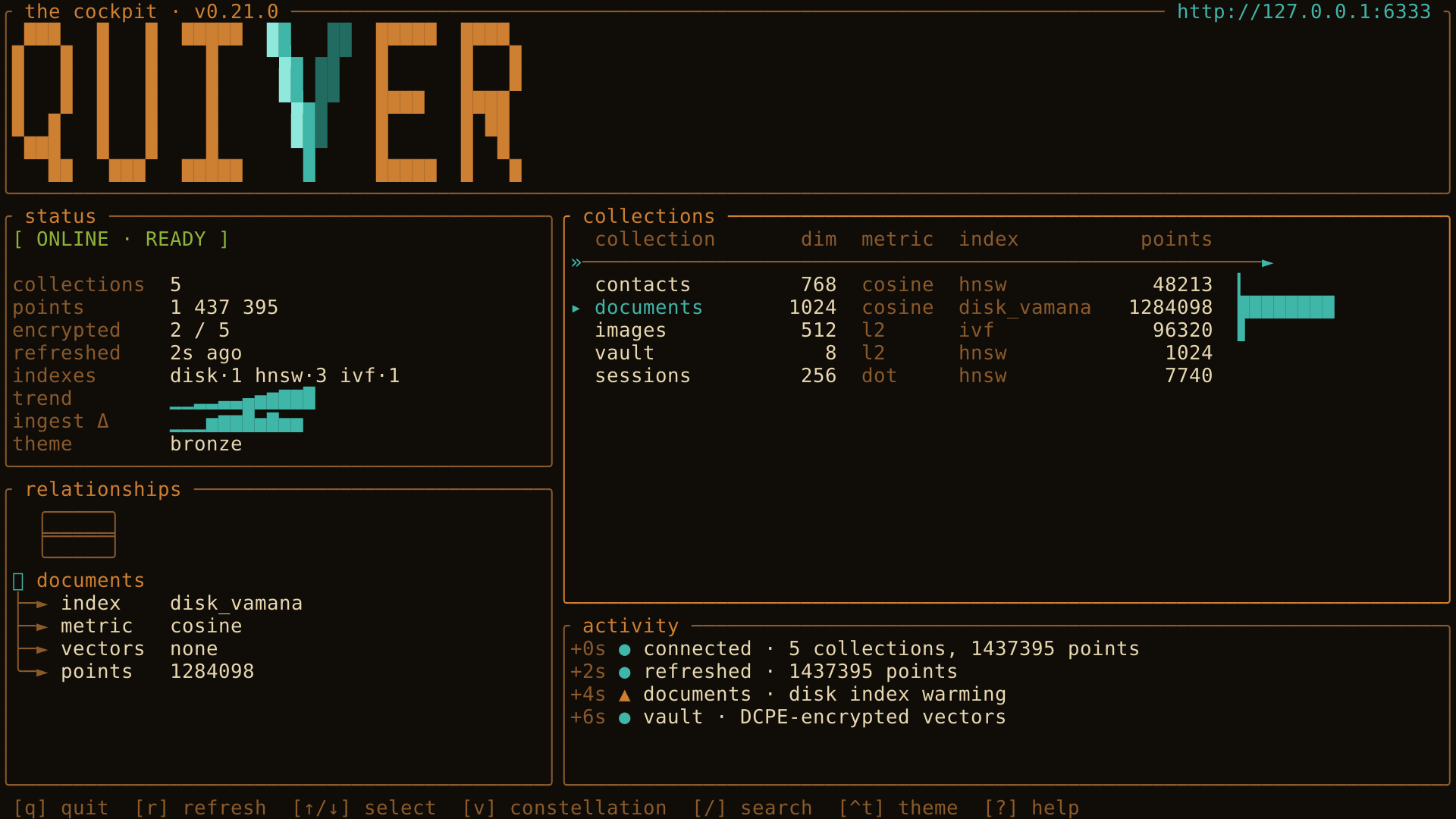
Quiver is a from-scratch, native-Rust vector database. It is not trying to out-scale Milvus or out-feature Qdrant; its defensible edge is the combination of three things, executed well:
- Security-first, by default. Encryption-at-rest is on out of the box, sealing
every durable byte — segments, the manifest, and the write-ahead log — with
XChaCha20-Poly1305. Payloads can be client-side-encrypted so the server never
sees them; vectors can be encrypted too, either with the experimental
distance-comparison-preserving DCPE mode or the
semantically secure client-side opaque mode.
API-key scopes, RBAC, tenant isolation, an audit log, and crypto-shredding round
it out. Only audited cryptography (RustCrypto AEAD/KDF +
rustls) — never a home-grown primitive. - Memory frugality. A disk-resident graph index (DiskANN/Vamana) plus quantization (product / scalar / binary) serve large datasets from a laptop’s RAM budget. The headline metric is memory at a fixed recall.
- Developer experience. A single static binary; embeddable and server modes;
a
ratatuicockpit with a 2-D constellation view of the vector space; idiomatic Python and TypeScript SDKs; and an MCP server so AI agents can drive it.
We say plainly what Quiver does not do: billion-scale needs a server (a laptop comfortably serves tens-to-hundreds of millions); there is no homomorphic search in core; and each encryption mode states its exact trust boundary. See the honest threat model.
The name. A quiver holds arrows, and an arrow is a vector — apt for a database of them. And in mathematics a quiver is a directed graph, which is exactly what an HNSW or Vamana index is. The cockpit wears that identity in amber phosphor.
Where to start
- New to Quiver? Read the Concepts, then run the Quickstart.
- Running it yourself? See Self-hosting & configuration.
- Building against it? See the REST & gRPC reference, the MCP server, and the SDKs.
- Curious how it works? Start with the architecture deep dive and the decision records.
Quiver is open source under the AGPL-3.0 license. The source lives at github.com/achref-soua/quiver.